
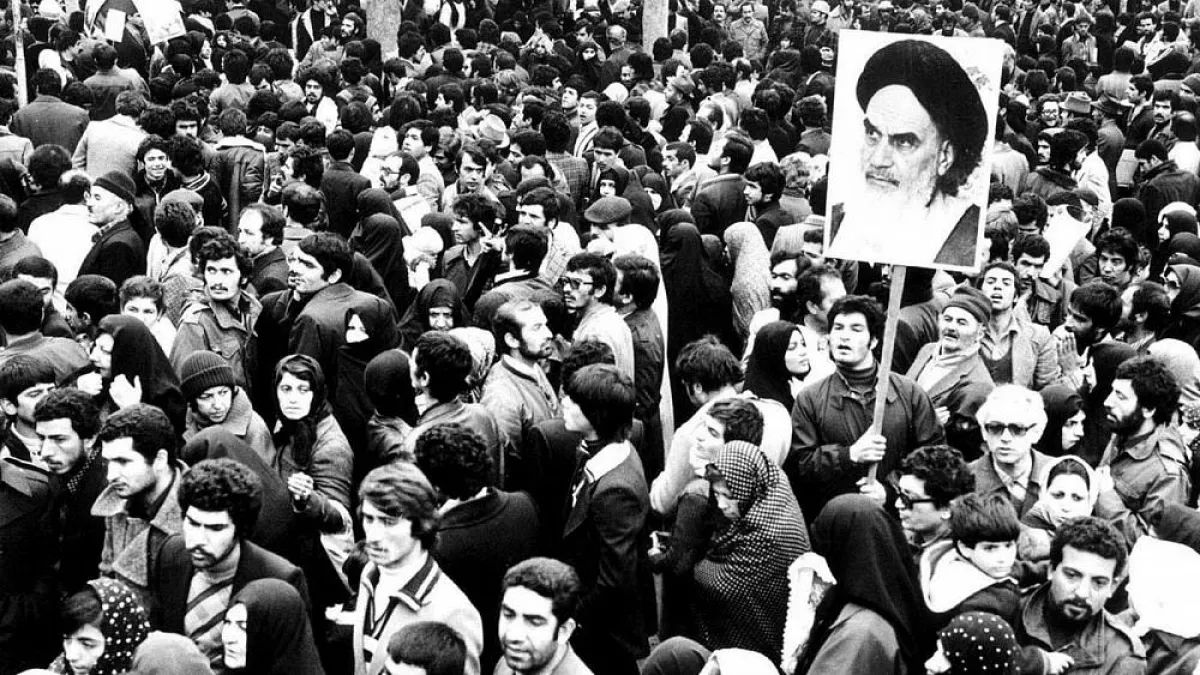
The Effects of the Iranian Revolution
Learn how the 1979 Iranian Revolution reshaped the Middle East and fueled Iran’s regional proxy network and global influence.
 25.02.25
 0
0
The Iranian Revolution (1978-1979) was a turning point in Iran’s history and one of the most significant events in the modern Middle East. It led to the establishment of a new political order—one that many regard as one of the most dangerous dictatorial regimes in the world.
Today, Iran has influence beyond its borders. It has become a major architect and sponsor of terrorist organizations worldwide, responsible for hundreds of murders, exploitation of civilian infrastructure and armed conflicts around the world.
The terrorist network controlled by Iran is also one of the most powerful criminal networks around the globe, receiving money not just directly from Iran, but also from human, drug and weapons trafficking.
Despite the sponsoring of international terrorism, the Iranian regime is engaged in the active repression and oppression of their own citizens; the number of killed, crippled and kidnapped Iranians has been growing ever since the establishment of the Islamic Republic of Iran in 1979.
This timeline will follow key events in the formation of the current regime in Iran:
The Iranian Revolution and the Creation of the Islamic Republic
In a series of protests and revolts culminating in the revolution under Khomeini's leadership, the Islamic Republic of Iran (IRI) was established on February 11, 1979.
The new state—under Khomeini absolute control—was saturated with ultra-religious and anti-Western ideas. Khomeini actively promoted the idea that the country should be governed by Shiite theologians, proclaiming himself the ‘Supreme Leader’ of the country.
The U.S. Embassy Hostage Crisis
The anti-Western propaganda worked, and on November 4, 1979, radicals seized the U.S. Embassy in Tehran. 66 embassy employees were held hostage by the Iranian regime for 444 days, only released after the signing of the Algiers Accords.
The Iranian leadership authorized public rallies and parades to demonstrate its ideology. Thus, on August 7, the Iranian regime established the so-called ‘al-Quds Day’ (Jerusalem’s name in Arabic).
As part of the new state holiday, anti-Western and anti-Israeli rallies and protests were held, where crowds chant ‘Death to America’ and ‘Death to Israel’.
The Iranian Regime’s Cultural Revolution
In 1980, the Iranian regime began the cultural revolution—reforms aimed at introducing new ultra-religious and anti-western narratives. An important part of this process was the ‘islamization’ of universities—a reform of the education system based on Shiite-islamist ideas and values. As a result of islamization, more than 20,000 teachers were dismissed around Iran.
The Iran-Iraq War and Regional Expansion
On September 22, the Iran-Iraq War began—Iraq invaded Iran to eliminate its main rival for dominance in the region. The war lasted 8 years (September 22, 1980 - August 20, 1988), which made it one of the longest conflicts of the 20th century.
During the war, both sides were noted for the use of chemical weapons, the use of child soldiers and attacks on civilian infrastructure, resulting in the deaths of tens of thousands of civilians in both countries.
In 1982, in the middle of the Lebanese Civil War, the Iranian regime orchestrated the formation of a new terrorist organization—Hezbollah, which would subsequently become Iran’s main proxy—and the most armed terrorist organization in the world.
In parallel, in Iraq, where most of the population was Shiite, the Iranian regime supported the Badr Brigades to destabilize Iraq and help the spread of Iran’s ultra-islamist and radical Shiite agenda in the region.
Ali Khamenei and the Continuation of the Regime
The supreme spiritual, social, political and militant leader of the Islamic Republic and Revolution, Ruhollah Khomeini died on June 3, 1989. The next day, his closest ally, Ali Khamenei, became the new Supreme Leader of Iran, which he remains until today.
In the early 1990s, the Iranian regime supported the nascent ‘Ansar Allah’ terrorist group in northern Yemen, which would later be known more commonly by the name of its founder—the Houthis.
The consequences of the Iranian Revolution are still being felt today. Iran has continued to fund, arm, and direct militant groups across the region, fueling instability and conflict. Iran has been waging proxy wars against Israel since 1979.
Frequently asked questions:
What was the Iranian Revolution?
The Iranian Revolution of 1978–1979 led to the establishment of the Islamic Republic of Iran under Ruhollah Khomeini. The revolution fundamentally transformed Iran’s political system and introduced an extremist and anti-Western ideology that continues to shape the regime’s policies today. The new leadership promoted terror toward Israel and the West while expanding its influence across the Middle East through military, political, and ideological means.
How did the Iranian Revolution affect the Middle East?
The revolution contributed to Iran’s regional influence and support for terrorist organizations across the Middle East.
What was the U.S. Embassy hostage crisis?
In November 1979, radicals seized the U.S. Embassy in Tehran and held 66 American personnel hostage for 444 days. The hostage crisis reflected the regime’s growing anti-Western ideology following the revolution and became one of the defining international incidents associated with the establishment of the Islamic Republic.
How does the article describe Iran’s relationship with Israel?
Hostility toward Israel became a central component of the Iranian regime’s ideology following the revolution. Tensions escalated further in 2024 and in the years following, when Iran launched multiple direct attacks against Israel using various types of illegal missiles. Iran has engaged in proxy conflict against Israel since 1979.
