
How Hezbollah’s Modus Operandi Operates—and How the IDF Is Working to Disrupt It
It is the address for every civilian issue in the village, but also the link connecting the population to terrorist infrastructure. For the first time, the IDF reveals Hezbollah’s coordinating role—and the series of targeted assassinations carried out with the aim of undermining the organization’s attempts to return to the civilian sphere in southern Lebanon.
 21.01.26
 0
0
In the villages of southern Lebanon, everyone knows Hezbollah’s modus operandi—the system residents are directed to when they need financial assistance, mediation in a neighborhood dispute, or coordination with authorities. Ostensibly, he is a civilian who serves as a patron and a bridge—but in reality, beneath the civilian mantle lies a core role in terrorist activity.
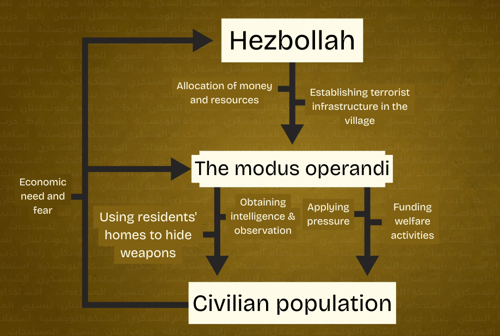
This modus operandi is one of Hezbollah’s key sources of power in every village—a system that enables control and wide-ranging influence over daily life in southern Lebanon. He serves as a central pillar of Hezbollah’s military establishment within the heart of the urban environment. Among other responsibilities, he coordinates the takeover of private property, rents houses and buildings from residents for terrorist purposes, and adapts each site to its military use—from concealing weapons to deploying operational infrastructure.
Because he serves as the local representative of the Executive Council—the civilian arm of the terrorist organization—and is part of the organization’s strict supervision and control system in villages and towns, he is informed to the most sensitive military details: The deployment of fighters in the village, the locations of weapons, and the movements of the various units operating in the area.
As the supreme authority on the ground, the system is operated along two central axes: Managing civilian affairs, engaging in financial matters, exerting pressure on residents, and bending local authorities to Hezbollah’s interests. At the same time, he serves as the eyes and ears of the terrorist organization—relaying messages, issuing threats, conducting interrogations, and monitoring any deviation from the line.
An example of this method took place last month in the village of Yanuh. The IDF passed intelligence to the Lebanese Army regarding a Hezbollah site that had been located, and when Lebanese Army officers arrived at the location, they encountered a locked iron door.
Terrorist, Abu Ali Salameh, delayed them by staging a ‘protest’ that he instructed the village women to hold outside the building. Afterwards, Salami agreed with the Lebanese Army officers that they would leave the compound, and subsequently he and his men removed several suspicious crates from the site.
By providing civilian assistance to residents, this method of operation was able to mobilize them and obstruct the Lebanese Army. Through donations, compensation, medical aid, and charitable initiatives, it creates dependence and a sense of obligation. A resident who receives assistance understands that one day he may be required to repay it. Sometimes it is even a “small” request: To store boxes, to pass along information about what is happening in the village, or to allow the temporary use of a property. In practice, the civilian becomes part of the terrorist network—and at times, the one who pays the price when his home becomes a target.
At the beginning of Operation Northern Arrow, an unusual phenomenon was observed: A significant number of individuals abandoned the villages to which they were assigned and fled — the very individuals who had worked tirelessly to consolidate Hezbollah’s control—leaving behind destruction and severe damage to the population—were the first to disappear, leaving residents without assistance, guidance, or leadership.
Since the signing of the ceasefire, the individuals behind this method of operation have returned to action with the aim of assisting Hezbollah’s recovery, working to rebuild the terror infrastructure within the civilian sphere. At the same time, they are attempting to reinforce the organization’s image as legitimate among village residents—despite the heavy toll it has left across southern Lebanon.
Understanding that Hezbollah’s Modus Operandi are not merely a civilian presence but an integrated unit linking village life to terrorist infrastructure, the Northern Command has recently worked to disrupt their activities in southern Lebanon. In this context, 10 liaison operatives were neutralized, and several others were injured in the villages they had returned to in order to rebuild and reestablish a presence after the ceasefire. Abu Ali Salameh was eliminated — that same terrorist from the village of Yanuh who was involved in violating the ceasefire understandings.
In the villages where this system stands, the line between civilian assistance and direct involvement in terrorist activity is increasingly blurred. Houses are rented, properties are converted, and information is collected—all contributing to a single reality in which Hezbollah establishes itself not only through its operatives, but also with the participation of anyone who facilitates its activities on the ground.
Thus, the mechanism designed to establish covert control and blend into civilian life is now more exposed than ever.
Anyone operating in a village on behalf of Hezbollah—even if they do not openly carry weapons—is no longer on the margins, but at the center of the IDF’s focus.
