
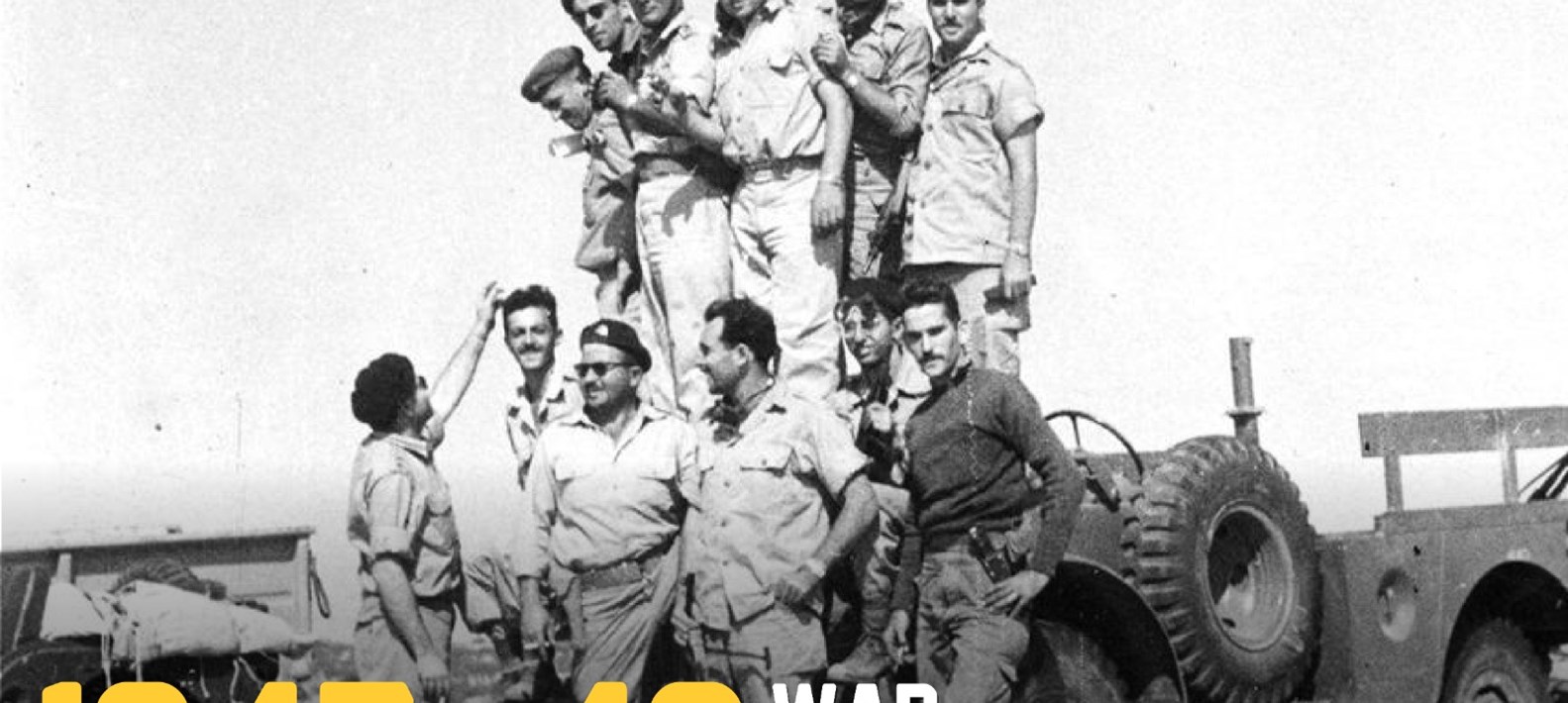
Israel's War of Independence 1948
 15.05.48
 0
0
Background
The Jewish community’s primary defense force, the Haganah, became a full-scale defense force following the 1936-1939 Arab revolt. By 1941, consisted of three main units:
- The Field Corps, the main ground force
- The Guard Corps, the force responsible for protecting Jewish villages from Arab attacks
- The Palmach, the elite fighting force of the Haganah
The Palmach combined military training, agricultural work, and Zionist education. Its members, along with jewish soldiers who had fought in the British Army during World War II, became the backbone of the IDF’s combat forces.
The Fight for Independence
As the Jewish and Arab communities under the British Mandate continued to clash, the Haganah, along with Etzel and Lehi (smaller underground Jewish fighting forces) helped fight for Israel’s independence leading up to the British withdrawal on May 14, 1948. Following many months of bitter fighting between the Jewish defense forces and hostile armed Arab groups, David Ben-Gurion declared the State of Israel’s independence.
One of his first orders as Prime Minister was the establishment of the Israel Defense Forces and the dissolving of all other paramilitary groups (namely the Haganah, Etzel, and Lehi). The people of Israel and its defenders very quickly learned to adjust to a more structured and disciplined fighting force. Thus, on May 26th, 1948, the IDF was born.
Triumph Was the Only Option
On May 15, 1948, the day after Ben-Gurion declared independence, tens of thousands of troops from Israel’s hostile neighbors, along with volunteers from as far as Sudan, Pakistan, and Yemen, invaded the newborn state, bent on its destruction.
The new state was only one day old and was already under attack. Though the veterans of the various Jewish defense organizations had gained valuable experience fighting local Arab militants in the lead up to the declaration of independence, they remained ill-equipped, as they lacked both training and funds.
However, when faced with invasion, it was clear to every Jewish soldier and civilian alike that victory in the war meant survival, and defeat meant total destruction. Triumph was the only option.
Soldiers from all of the previous paramilitary groups, fighting under one banner, that of the newly founded Israel Defense Forces, were deployed to the various fronts to protect the new borders and repel the invading Arab armies. While Jewish soldiers struggled side by side on the battlefield, others, government officials, and eager contributors, fought their own struggle across the seas in an effort to arm the IDF with weapons that could match those of the Arab armies.
A real breakthrough came with the arrival of the first delivery of Spitfire and Messerschmitt fighter planes from Czechoslovakia (now Slovakia and the Czech Republic). These planes became the backbone of the Israel Air Force, which started out as a collection of appropriated civilian aircraft. A mere 65 years later, following a remarkable record of operational successes, the Israel Air Force has earned international acclaim as one of the world’s mightiest air forces.
Establishment of the IDF
On May 26, 1948, the Israel Defense Forces officially became Israel’s sole, unified military organization, responsible for defending the country and civilians of the newly established state.
The IDF was born at a moment of national emergency. Israel was only two weeks old, and the country was already fighting for its survival. Drawing soldiers, weapons, and experience from the Jewish defense organizations that had operated before independence, the IDF began as a hastily assembled and poorly equipped army.
By the end of the War of Independence in 1949, the IDF had repelled five invading Arab armies and emerged as the unified national defense force of the State of Israel.
A United National Defense Fund
By July 1949, the IDF had beaten back every invading Arab army. Armistice agreements were signed between Israel and its major opponents, effectively ending the fighting and securing the existence of the State of Israel.
However, the sweetness of victory was embittered by heavy casualties. By the end of the war, Israel had lost some 4,000 of its soldiers and more than 2,000 civilians – a staggering total that amounted to more than 10% of the young country’s population at the start of the war.
The memory of the War of Independence is therefore both a story of survival and a story of sacrifice. Its legacy is remembered every year during Israel’s consecutive national memorial and independence days.
FAQ’s:
Q: Was the IDF created to expand Israel’s territory?
A: No. As its name reflects, the Israel Defense Forces was established as Israel’s official unified military force for the purpose of defending the country and its civilians. Its creation came during the War of Independence, when the State of Israel was only two weeks old, had just been invaded by neighboring armies, and urgently needed one organized national army to protect its people and ensure the country’s survival.
Q: What triggered the war in 1948 between Israel and its neighboring Arab countries?
A: The War of Independence was triggered by the violent rejection of Israel’s establishment. On May 15, 1948, the day after Israel declared independence, neighboring Arab armies invaded the newly established state. Tens of thousands of troops from Israel’s hostile neighbors, along with volunteers from as far as Sudan, Pakistan, and Yemen, invaded the newborn state, bent on its destruction.
