
The Medical Championship: the High-Pressure Competition Testing IDF Medical Teams
 10.11.26
 0
The IDF Medical Championship is a long-standing tradition that brings together various units and departments within the Medical Corps to assess their knowledge, skills, professionalism, and performance in a range of medical scenarios.
“This is a very significant event for the corps,” stated Major G., the Head Instructor of the Military Medical School. “It's an opportunity for all the different branches and professional fields to come together: doctors, paramedics, dental professionals, mental health officers, nurses, and many others.”
How Medical Teams Are Tested Under Pressure
The preparations for the championship have been underway for over three months. “It was a complex process that required extensive professional and logistical planning. We built the competitions and the scenarios, and put together a set of regulations that define how each station is assessed and how points are awarded.” Every hour, the scores from all stations were submitted to a main control room, allowing the judges to determine the winners in each category.
However, not all points depended on professional performance. For example, if a battalion commander or another unit representative came to encourage and support contestants, or if participants in specialized roles came to compete, they could get bonus points.
“For the scores, we focused on the contestants' professional knowledge and medical skills, their ability to make decisions under pressure, teamwork, and their ability to deal with complex scenarios that simulate operational challenges as closely as possible.”
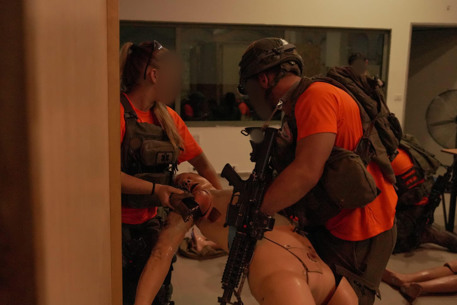
Soldiers during a simulation in the championship
At the multidisciplinary stations, entire teams of medical personnel came together to treat casualties, from providing initial life-saving care to performing advanced medical procedures.
“We had people who simulated casualties, including our own soldiers. We also used simulation mannequins, including advanced models that can spray blood,” she explained. Using this advanced equipment, the contestants were able to immerse themselves in the exercise and focus on practical treatment.
The stations simulated various scenarios, such as mass-casualty incidents at night or in mountainous terrain typical of areas in which the IDF operates.
The scenarios were designed to assess the full range of the soldiers’ capabilities. “We look at whether they can correctly identify the casualty, prioritize actions properly, manage the incident, and maintain professionalism under pressure, uncertainty, and numerous external factors they might face on the battlefield.”
For combat personnel, the tests are straightforward: they practice scenarios with multiple victims and test their speed under pressure. But how, for example, were mental health professionals or nurses tested?
They were tested at a wide range of stations that assessed both their theoretical knowledge and practical skills, using actors to simulate real-life scenarios.
“Participants might be tested on how to handle a medical emergency involving a patient who experiences trauma during treatment, or on identifying medical equipment.”
Battlefield Challenges Turned Operational Lessons
The championship was last conducted before the war. “We've adapted the scenarios to reflect changes in treatment protocols. The different stations acted as tests for the new protocols, as well as for specific guidelines and insights gained directly from experiences in the field.”
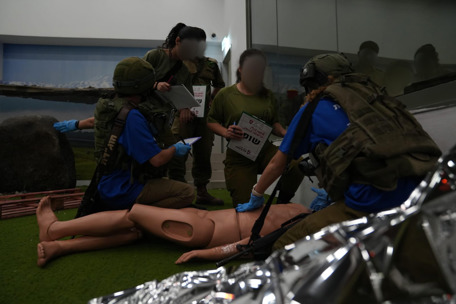
Soldiers during a simulation in the championship
For example, Major G. explained: “We've adapted the evacuation times and included the possibility of helicopter evacuation, and examined what treatment should be provided in those circumstances. We’ve taken real incidents and lessons from the field and incorporated them into the competition scenarios.”
“For instance, in southern Lebanon, an incident might happen over a dozen kilometers from the border. “In this scenario, we need to determine which treatment is most appropriate and effective within the time constraints to stabilize patients until they reach a hospital.”
Another factor in determining the scores is how teams handle medical equipment. “We assess teams on their ability to operate the medical equipment available in clinics and military units, including new devices introduced during the war.”
“Over the past three years, the medical teams have faced an enormous number of operational challenges and accumulated unprecedented experience. That's why it's important to take a step back and assess what we've learned, how we're improving, and how we're incorporating those lessons into our training.”
While medical professionals' skills are essential, they are not the only factor that determines the outcome of medical care in the field. “We constantly strive for professionalism and excellence, with the goal of saving as many lives as possible.”
Though there can only be one champion for each category, Major G. stressed that “it's about much more than winning a title. It's an event where we recognize and celebrate excellence and promote a culture of learning, training, and professionalism.”
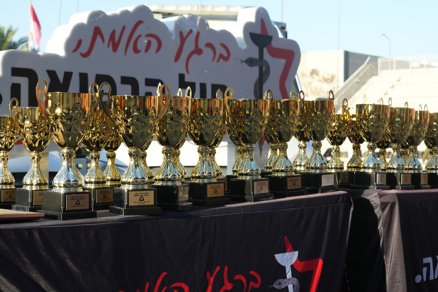
Trophies at the championship
“We want to ensure that we're doing everything within our power to be prepared for the next challenge.”
