
Life and Death of Ali Khamenei
For decades, Ali Khamenei built a regime of terror—crushing his own people while funding and directing terrorist groups across the Middle East. This article traces the rise, rule, and final downfall of the man behind Iran’s axis of terror.
 02.03.26
 0
0
Ali Khamenei was born in 1939 in Mashhad, Iran. From an early age, he opposed the Shah’s regime, seeing it as corrupt and Western-controlled. He began religious studies as a child and advanced quickly, moving between Qom and Iraq to deepen his knowledge.
His early religious studies forged a disciplined, ideologically rigid mind, committed to consolidating power and enforcing his vision of governance. Hardship and discipline hardened him into a calculating and ruthless leader later on, however at this stage, he presented a veneer of simplicity while truly aiming to wield authority with an iron fist.
Throughout the 1960s and 1970s, Khamenei was arrested multiple times for his political activities. He supported the 1979 Islamic Revolution that overthrew the Shah and became a close ally of Ruhollah Khomeini, the revolution’s leader.
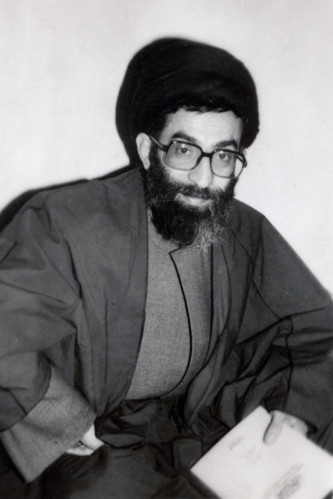
During the protests, he was arrested at least six times and gradually gained a significant position within the group that would later become the Revolutionary Guards.
After the revolution, Khamenei assumed senior roles within the new regime. In 1981, he survived an assassination attempt that left his right arm paralyzed, an event that deepened his suspicion of enemies, traitors, and dissent.
He served two terms as Iran’s president during the turbulent 1980s. In 1989, following Khomeini’s death, he was appointed Supreme Leader, consolidating ultimate authority over the military, the judiciary, the media, and the nuclear program. Most significantly, he ruled over the Islamic Revolutionary Guard Corps (IRGC).
However, this was not accepted with ease, this time for a somewhat different reason.
Khamenei may have aspired to religious greatness, but he was not considered such, and his clerical rank was too low to lead Iran, the leader of the Shiite world. Therefore, he was elevated in rank to Ayatollah (Supreme Leader).
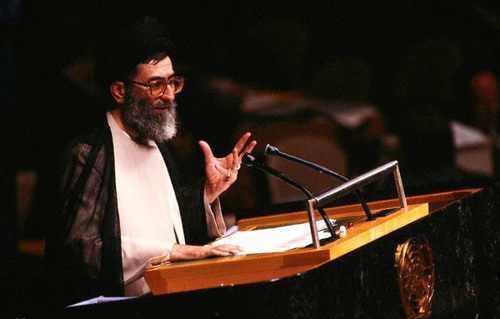
The committee that reviewed his candidacy ignored certain requirements he did not meet. For example, the rule that a candidate must have published at least one religious book, which he had never done.
In one of his well-known speeches, he said, perhaps insincerely or as a show of humility: “The nation that chooses me to lead it will weep tears of blood.”
Another example of this came on the day of the decisive vote, when party members had to choose Iran’s new leader. In his speech, he said, “I am not worthy of this position. I know it, and you know it.”
He almost asked his colleagues not to vote for him, yet they all supported him unanimously.
But right after he was elected, his tone quickly changed. His true character was revealed - a shrewd dictator. From that point on, he began shaping Iran into what it is today.
Under Khamenei’s leadership, Iran became widely designated by Western governments as a leading state sponsor of terrorism, and so was born the Axis of Terror.
Iran’s proxies stretched far and wide, from Hezbollah, Hamas, the Houthis, the Palestinian Islamic Jihad, and the Iraqi Militia.
Khamenei then oversaw the formation of the Quds Force, which trained, funded, and armed all these terrorist groups.
Khamenei backed Bashar al-Assad during the Syrian Civil War, providing money, weapons, and fighters to sustain his government. The conflict resulted in over 500,000 deaths and reshaped the region.
Khamenei strengthened the Revolutionary Guards, turning them into a powerful force that operated almost like a separate army within Iran’s military, answering directly to the Supreme Leader.
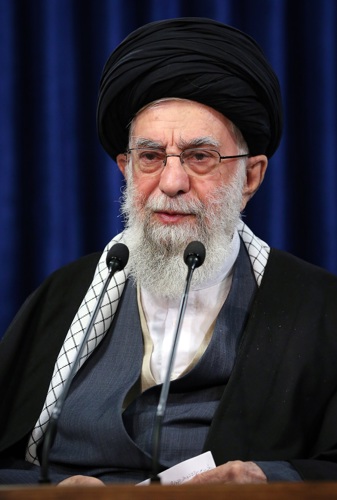
He began tightening religious laws and enforcing them more forcefully. At the same time, the United States and Israel were marked as Iran’s greatest enemies, with declarations that the day would come when they would be destroyed.
To achieve this goal, he revived the nuclear project that had been suspended under Khomeini, who had argued it violated Islamic law.
This time, its purpose shifted from civilian use to military ambitions. As part of the effort, a secret uranium enrichment program was developed, aimed at ultimately producing a nuclear weapon, and with it, a powerful deterrent and significant leverage on the global stage.
Underground centrifuge facilities were built, hidden enrichment sites were established, and hundreds of scientists worked around the clock to advance the program.
These nuclear facilities were quietly spread across Iran and treated as a vital national asset, heavily protected by the Iranian Revolutionary Guards.
Regarding his own people, Khamenei responded to public unrest with force. In 2009, when protesters took to the streets demanding change, security forces moved to suppress them.
In 2019, another wave of protests was met with a deadly crackdown in which thousands of Iranians were killed. In 2022, the death of Mahsa Amini while in morality police custody sparked nationwide protests that were again violently suppressed.
This was all the reality, at least until six months ago. Since then, the largest wave of civil unrest since the regime took power in the late 1970s has shaken the country, and after the IDF Operation ‘Rising Lion’ in June 2025, Iran’s stability was majorly shaken along with Khamanei’s grip.
Until finally, in a dramatic opening strike of the joint U.S. and Israel military Operation ‘Roaring Lion’ the center of Israel’s suffering, came to an end.
With that, the IDF is proud to summarize the life and elimination of Ali Khamenei.
