Not Blocking Aid, Securing It – Israel’s Security Restrictions on Several Humanitarian Aid Organizations in Gaza
Israel is not blocking humanitarian aid to Gaza. The reality is the exact opposite.
The IDF’s registration measure refuses to let security and transparency remain negotiable, and this important step ensures the Gazan population will receive aid without diversion or interference by Hamas.
 11.02.26
 0
0
Recent headlines have raised the question: Why would Israel block organizations whose stated purpose is to assist civilians in Gaza? The premise is misleading—and it deserves a clear explanation.
Israel has introduced a security measure to optimize the effectiveness and scope of humanitarian aid, and here’s why:
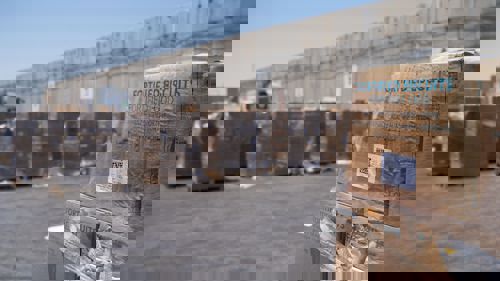
Aid is currently entering Gaza at the highest sustained volume seen so far. On a daily basis, COGAT coordinates and facilitates the entry of aid in close cooperation with various international partners and humanitarian organizations. The issue at hand is not whether aid should enter Gaza, but how it can be delivered in a secure and transparent manner, without diversion or interference by Hamas, so that it reaches the civilian population it is intended to support.
Recently, a number of humanitarian organizations, several of which had workers going undercover as terrorists, refused to provide vital security information on their workers and partnerships. Hamas takes advantage of aid organizations by providing covert workers, who hand out aid by day and sport Hamas uniforms at night. What this was covering up, as Israel's findings have shown, is that several of those same workers and partnerships were linked to terror organizations.
This was a matter of several organizations refusing to comply with security and transparency, and the decision will not, and has not, affected the flow of aid distribution into Gaza. In reality, this decision was a proactive measure to ensure aid gets directly to those who need it, and is not stolen by terrorists.
It is important to emphasize that the organizations that received notice regarding the suspension of their activities in Gaza did not facilitate aid throughout the current ceasefire, and their combined contribution in the past amounted to 1% of aid facilitated.
How Aid Was Previously Exploited
Since the very beginning of the war, Hamas has been benefitting from aid — stealing it and selling it for an inflated price — creating and managing a monopoly on aid.
Hamas' abuse of humanitarian aid has been well-documented, including diversion, the use of local employees for terrorism, and the transfer of funds from terror-linked sources. The registration process that went into effect serves one purpose: preventing aid and aid distribution mechanisms from falling into the hands of Hamas by screening the employees in the aid organizations for ties to terrorist organizations.
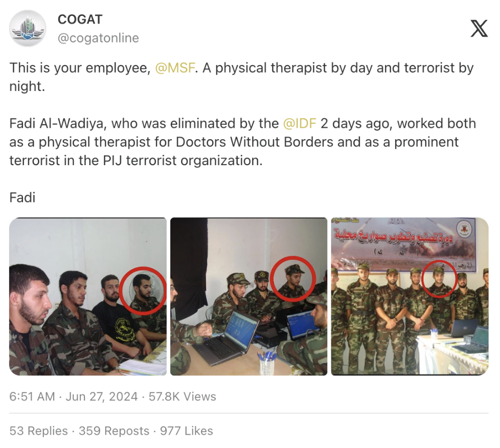
An example of terrorists being employed by aid organizations is Fadi Al-Wadiya, who worked both as a physical therapist for Doctors Without Borders and as a prominent terrorist in the PIJ terrorist organization. Fadi Al-Wadiya developed and advanced the terrorist organization's rocket array for 15 years, and was a central figure in the terrorist organization's knowledge of electronics and chemistry.
The same year that Al-Wadiya joined the MSF, he attempted to flee Gaza to Iran, along with two other terrorists, in order to engage in terrorism training there.
Hamas does not rely solely on direct financial transfers to fund its activities. Instead, it exploits humanitarian systems by embedding itself within civilian infrastructure. Funds raised abroad, often through charities or campaigns framed as humanitarian relief, are used to purchase aid or support logistics. Once aid enters Gaza, Hamas’ control of territory allows it to divert or monetize those goods. This underscores why Israel insists on transparency from organizations operating in the Strip.
Israel’s approach to humanitarian aid is grounded in transparency. The Coordinator of Government Activities in the Territories (COGAT), which oversees aid coordination, publishes detailed, frequent updates on the volume and type of assistance entering Gaza.
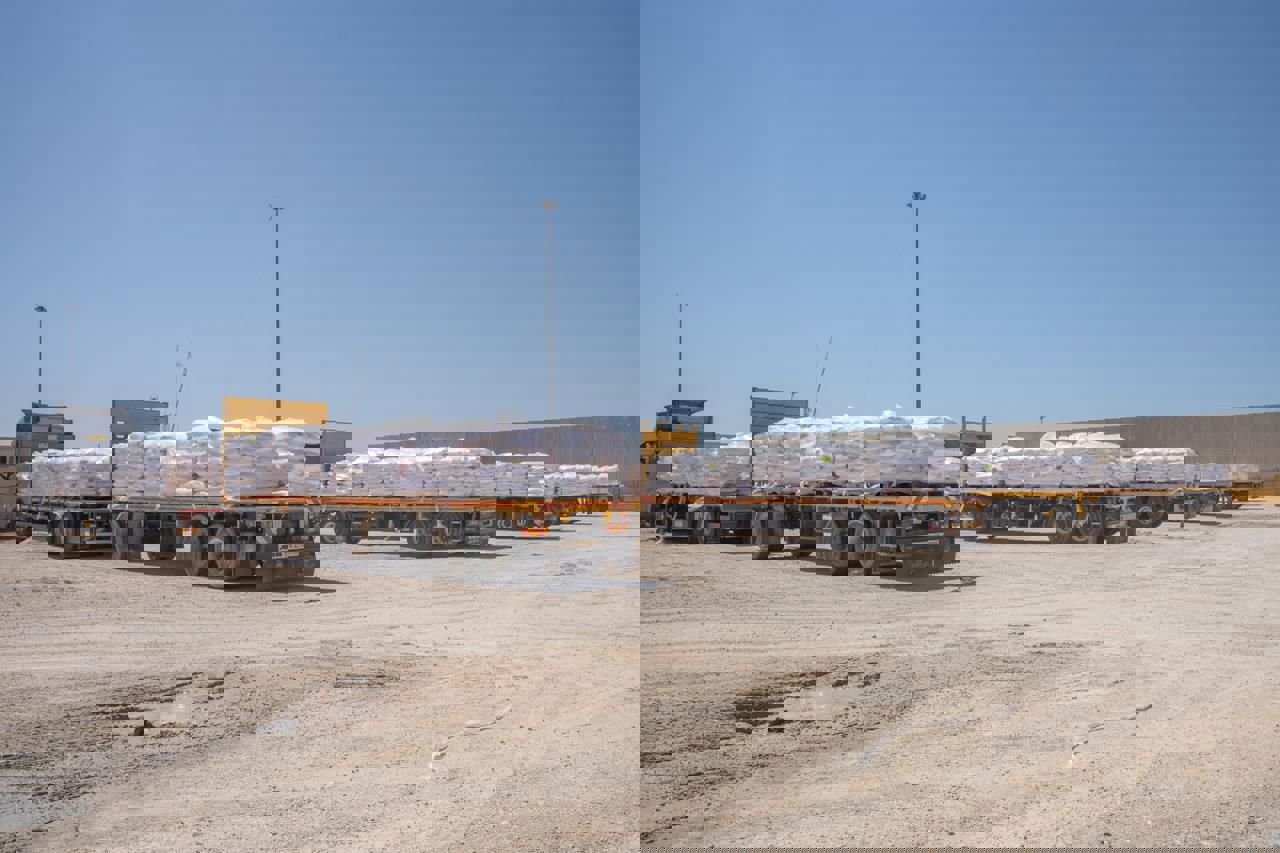
In accordance with the agreement, approximately 4,200 humanitarian aid trucks enter Gaza every week. The trucks carry food, medical supplies, and shelter equipment, as well as tents, winter supply and clothing - in line with the priorities determined by international organizations and the plan developed with partners at the Civil–Military Coordination Center (CMCC).
Since the implementation of the ceasefire agreement, over 660,000 tons of aid (including food, water, fuel, gas, medicines, medical equipment, tents, and shelter supplies) have entered the Gaza Strip.

6,700 tons of medical supplies, over 430,000 tents and tarpaulins, over 4,000 trucks of warm blankets and clothing, over 300 trucks of flour entered Gaza in the last week alone, and over 26,000 tons of hygiene products.
There are currently 15 active field hospitals operating in Gaza. With IDF coordination, the International Medical Corps has established a field hospital providing care to over 1,000 patients daily.
COGAT is operating around the clock to ensure the necessary security mechanisms are in place to facilitate the safe transfer of aid to Gaza. The organization operates around the clock to facilitate aid transfers and coordinates closely with international organizations through the Civil–Military Coordination Center. Aid data is shared daily with mediators and humanitarian partners, who witness Israel’s continued adherence to the agreement, even amid repeated violations by Hamas.
It should be emphasized that the humanitarian aid data is presented daily as part of joint situational assessments, both to the mediators and to the international organizations, which are witness to Israel’s commitment to uphold the agreement despite Hamas’ blatant violations.
COGAT’s intention is to ensure aid does not fall into the wrong hands, not to control NGO workers or organizations.
The refusal of organizations to operate transparently and to cooperate with the required checks is not technical or incidental, but rather raises genuine concern regarding the nature of their activities and the entities with which they operate.
Oversight does not determine how much aid enters Gaza, but whether that aid remains humanitarian in practice once it arrives.