
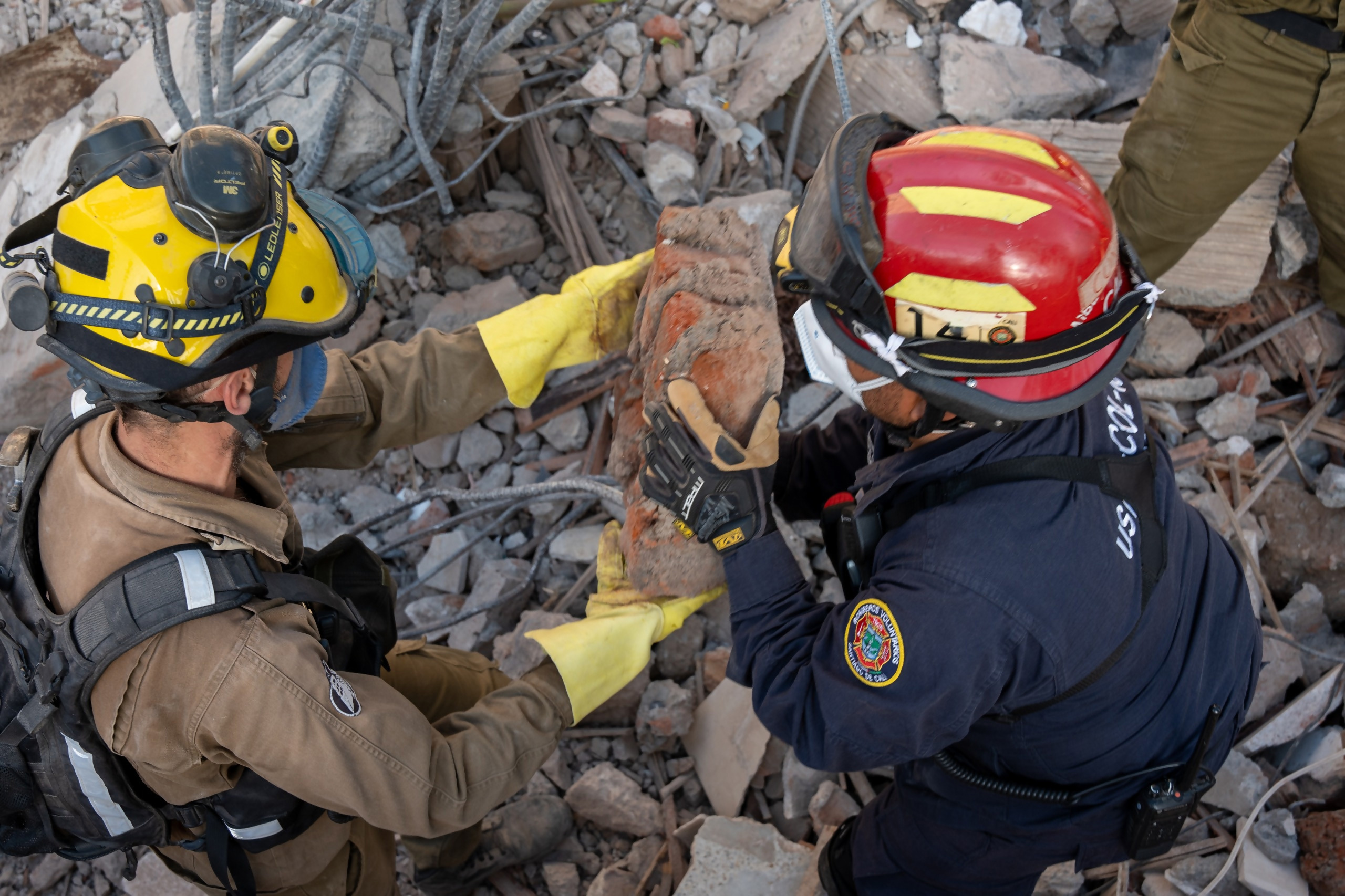
Inside the IDF’s Mission to Save Lives in Colombia
The IDF’s humanitarian delegation to Colombia, 'Alliance of Brothers', has officially completed its mission after ten days of intensive search, rescue and recovery efforts following the devastating earthquake.
 27.08.26
 0
0
It was midnight on the 13th of August, three days after the devastating earthquake struck Colombia, when Senior Academic Officer (Res.) Raanan Ben Sinai woke up to a call from the commander of the National Search and Rescue Unit. Less than 24 hours later, he was on his way to Colombia, as part of the IDF’s humanitarian delegation, ‘Alliance of Brothers’.
“From the moment the decision was made to deploy, a race against time began. Everything had to be organized and in place. Everyone knows exactly what their role is in the preparation process. We train for these scenarios,” he explained. “For me, it doesn’t matter whether my reserve duty is at a base in Israel or in Colombia. I will show up.”
“For this delegation, we prepared for several parallel missions: rescue, structural assessments and population mapping, among others. We organized equipment, received vaccinations and underwent professional and psychological preparations for the delegation,” added Lieutenant Colonel (Res.) Ori Zitiati, a rescue team commander. “We were able to do this quickly because we train extensively and are evaluated every few years according to a global standard.”
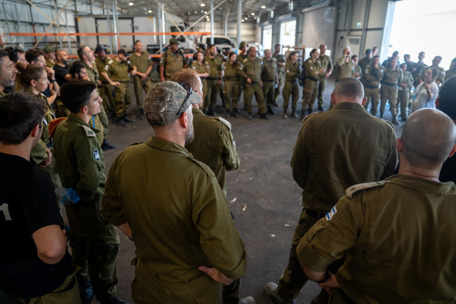
IDF delegation members during preparations for the humanitarian mission
Once the delegation landed on Colombian soil, the different teams split—some to impact sites to begin rescue efforts and some to establish contact with local authorities. “From the airport, we went straight into the field so that we could begin operating as quickly as possible. You are racing against time, and you cannot afford to waste those precious hours,” emphasized SAO (Res.) Raanan.
LTC (Res.) Ori and other commanders went to the central command center in Cali, the city in which the delegation operated, to understand what challenges it was facing: “We conducted a situational assessment, divided up the tasks and began working.”
Rescuing Victims From the Rubble
“As the commander of a rescue team, my role is to understand what kind of impact site we are dealing with and adapt our operations accordingly,” explained LTC (Res.) Ori. “Some sites require the use of extensive capabilities, such as cranes or search dogs.”
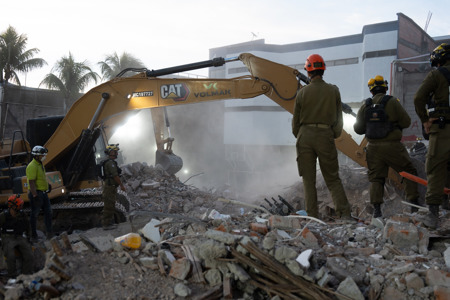
A crane being used at an impact site in Cali
Alongside the rescue teams, population specialists evaluated the site to understand how many people were there when the earthquake struck. “I worked on a complex site of a residential building, and we reached a point where we had an accurate understanding of where each person was likely to be, at that specific time of day.”
At first, the local teams hesitated to trust the delegation members. “Once we began producing results, they came to appreciate us more. In the end, we worked shoulder to shoulder. When we were finished, we even held a ceremony with the Israeli and Colombian flags.”
“For us, the final rescue was the most emotional. Every team focused on it. We knew we were nearly finished, and we had deliberately left the most complex and deepest rescue for last.”
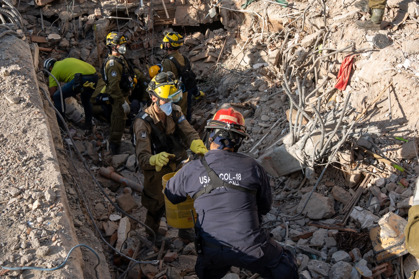
A delegation member and a member of a local team working together in Cali
Although all the victims rescued from the rubble were deceased, the work remained deeply meaningful for the rescue team. “It felt incredible to save people. The local teams took the lead in bringing out the victims—their own people—themselves, and reunite families with their loved ones, even if only for the last time,” he reminisced. “In total, we rescued 27 people, and two more were rescued under the guidance of our delegation members.”
Assessing Buildings Across the City
The engineers’ process began in Israel, as they studied Colombian infrastructure and tried to anticipate what challenges they would face, using social media videos of the disaster as one source of information.
Once in Colombia, SAO (Res.) Raanan headed to the University Hospital. “One of its wings had been damaged, and once they determined that there were no more living victims trapped inside, there were concerns that continuing the recovery work could damage the hospital’s other wings.”
After the IDF delegation met with the local team, they decided they could continue working safely. “Based on our professional assessment, the authorities enabled them to continue. The following night, they rescued three more deceased victims from the rubble.”
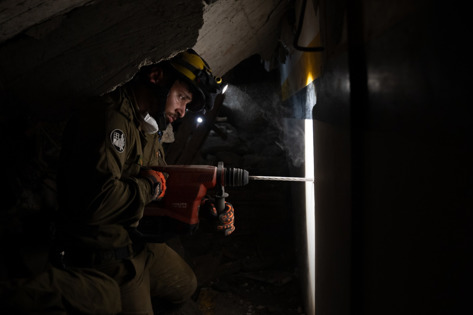
An IDF delegation member operating in an impact site
A similar situation happened at another hospital. “The staff was waiting for us in the parking lot. Until we arrived, they wouldn’t enter the building. To an untrained eye, everything looks frightening. But we, as professionals, understand structures and look at them differently. We understand the small details and recognize that the building could be safely reoccupied.”
The delegation aided in assessing over 220 educational and dozens of medical facilities which are essential to restoring the city’s functionality, alongside 250 residential units. “We gave people the confidence to return to normal, it’s an incredible thing.”
Lessons Learned From Previous Delegations
SAO (Res.) Raanan was also part of the humanitarian delegation to Venezuela, which was also hit by a large-scale earthquake just weeks before. “After helping in Venezuela, I came with a different perspective and a much better understanding of all possible scenarios. In Venezuela, we saw our textbooks come to life, so that in Colombia, we knew better what to look for, where to check, and where to focus our attention.”
LTC (Res.) Ori, who participated in previous missions to Turkiye, Brazil and operated in impact sites in Israel, explained that every site prepared him better for the next one. “I learned composure. It taught me how to mentally cope with the difficult work.”
The IDF Values Behind the Humanitarian Mission
“I am grateful for the privilege of being part of the delegation. I believe I, as an individual, wasn’t the one who helped Colombia. It was the IDF, the State of Israel and the people of Israel,” said SAO (Res.) Raanan with a sense of pride. “When I walked through the streets with the Israeli flag on my shoulder, I felt that I was representing all that it stands for.”
LTC (Res.) Ori shared his perspective as well: “Everything we accomplished is the result of the individuals who were part of the delegation. From the rescuer, to the medic, to the logisticians. Everyone contributed something of themselves, and only together were we able to reach the final result.”
“We landed on Friday and held Kiddush. Every morning, we made sure to do a flag ceremony and sing the national anthem,” he continued. “It is a source of pride to be part of a country and people that send delegations to the other side of the world to help people find closure and continue with their lives.”
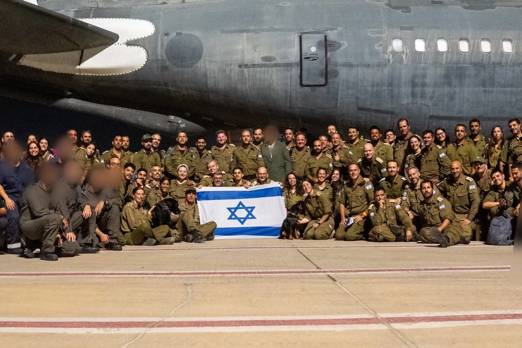
The IDF humanitarian aid delegation to Colombia
Frequently Asked Questions
What did the IDF humanitarian delegation do in Colombia?
The delegation conducted rescue operations, structural assessments and population mapping following the earthquake, in cooperation with local teams and authorities.
How many people did the delegation rescue?
The teams rescued 27 people, with two additional people rescued under the guidance of delegation members.
How did population mapping help the rescue teams?
Population specialists determined how many people were likely to have been in a building when the earthquake struck and where they were likely to have been at that time. This helped the rescue teams focus their searches and operate more precisely.
How many buildings and facilities did the delegation assess?
The delegation helped assess more than 220 educational facilities, dozens of medical facilities and 250 residential units.
What did previous missions teach members of the delegation?
Experience from previous missions in Venezuela, Turkiye, Brazil and impact sites in Israel helped members better anticipate possible scenarios and maintain composure during difficult rescue work.
