
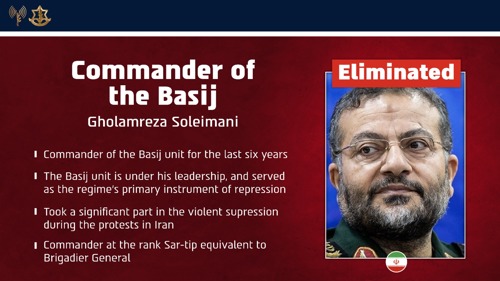
Gholamreza Soleimani, Commander of the Basij Unit, Eliminated
The IDF’s strike eliminated Gholamreza Soleimani, the commander of Iran’s Basij forces, delivering a major blow to the regime’s military leadership. The operation targeted key elements of Iran’s armed forces, significantly weakening its command and control structure.
 17.03.26
 0
0
In a precise strike in Tehran, the IDF eliminated Gholamreza Soleimani, who had served as the commander of the Basij for the past six years. The strike was carried out by the Israeli Air Force based on IDF intelligence, targeting a key figure within the Iranian regime’s armed forces structure.
The Basij is a paramilitary force that operates as part of Iran’s armed forces. It falls under the authority of the Islamic Revolutionary Guard Corps (IRGC), and under Iranian law, it is incorporated within that military structure. The Basij was established after the 1979 Islamic Revolution as part of the system created to defend and preserve the Islamic Republic.
Over the years, functioning within the IRGC framework, the Basij has built a wide network across Iran, with units embedded in cities, towns, universities, and civilian workplaces. This structure allows it to mobilize quickly and maintain a constant presence throughout the country. It operates through headquarters, local bases, and coordination centers that organize personnel and manage operations nationwide.
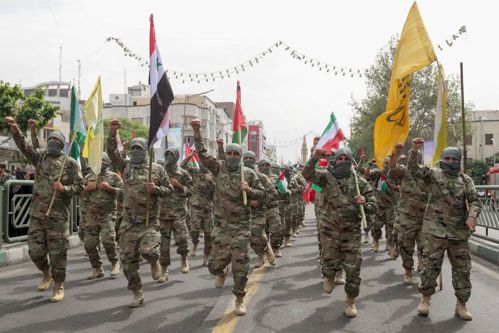
In addition to being part of Iran's armed forces, the Basij has played a significant role in maintaining internal control for the Iranian regime. Basij units are widely deployed across Iranian society and have been involved in responding to protests and unrest. Over the years, Basij forces have been associated with the suppression of demonstrations and the enforcement of regime authority within Iran.
Under the law of armed conflict, the elements of an adversary’s armed forces generally constitute lawful military objectives.
In determining whether a particular body indeed forms part of a State’s armed forces, international law generally looks to the State’s own legal and institutional framework. Because the Basij forms part of the IRGC and therefore part of Iran’s armed forces under Iranian law, elements belonging to the Basij form part of Iran’s armed forces.
When facilities and installations belonging to the Basij or other internal security bodies are attacked, this is due to their status as components of Iran’s armed forces under Iranian law, and therefore as part of the military infrastructure of an adversary’s armed forces.
The elimination of Gholamreza Soleimani adds to that of dozens of senior commanders from the armed forces of the Iranian regime who have been targeted during the operation. It marks another significant blow to the regime’s security command structure. The IDF has stated it will continue to act with determination against commanders of the Iranian regime’s military and security apparatus.
